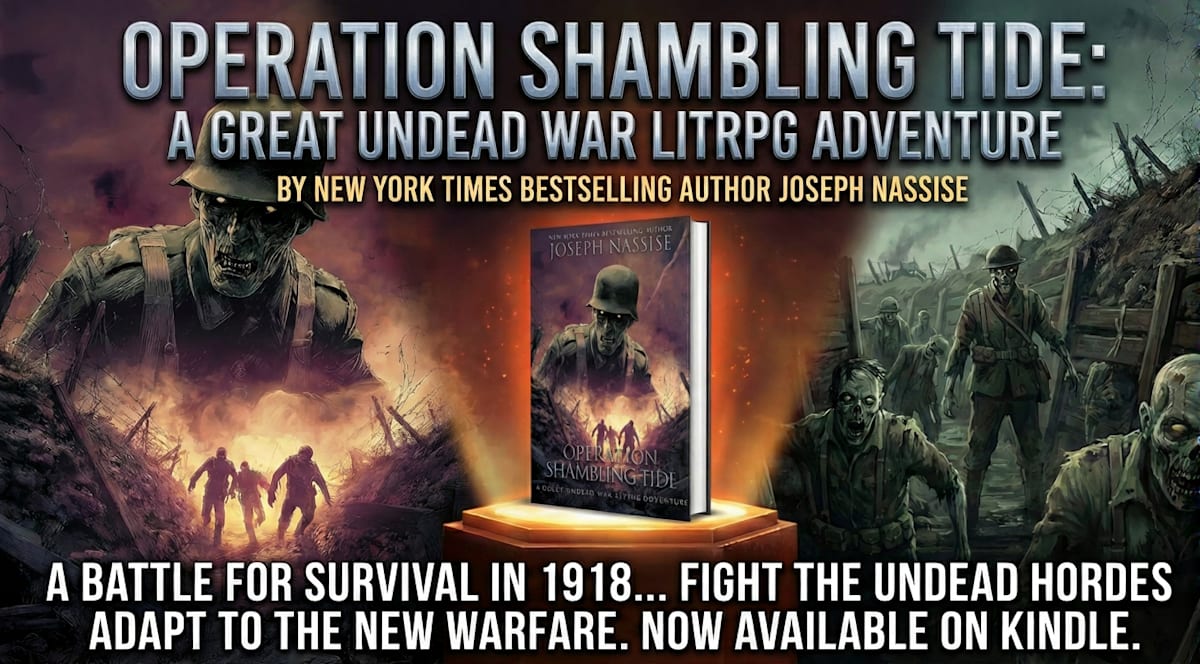
In honor of Tuesday's launch of Operation Shambling Tide, my first LitRPG novel, I'm sharing the first two chapters here for your enjoyment!
Chapter One
Afghanistan
The HMMWV’s engine growled beneath Sergeant Solomon “Sol” Drake as he navigated another pothole in the cracked asphalt road. Dust clouds billowed behind the convoy, coating everything in a fine layer of tan grit that had become as familiar as breathing during his fifteen months in this godforsaken country. The Big Red One patch on his left shoulder—the same crimson numeral his grandfather had worn storming Omaha Beach—caught the harsh Afghan sun through the windshield.
Another day in paradise, he thought, adjusting his grip on the steering wheel as the vehicle bucked over uneven terrain.
The radio crackled with the easy banter between the two HMMWVs, call signs Bravo One and Bravo Two. Drake drove the trailing vehicle, keeping precise distance from Private Deacon "Beanpole" Smith's lead truck—close enough for mutual support, far enough apart that a single IED couldn't take them both out. Above him, Corporal Nathan “Haystack” Hemmings manned the .50 caliber M2 machine gun in the turret, his boots occasionally shifting against the metal flooring as he scanned the terrain. Privates Bill “Hunter” Hopkins and Steve “Wall-Eye” Washrow occupied the back seat.
"How copy, Bravo Two, over?" Smith's voice filtered through the comm system, tinged with the easy confidence of a nineteen-year-old who'd survived eight months of convoy runs.
Drake keyed his handset. "Lima Charlie, Beanpole. Road's looking good from back here. Over."
"Roger that, Sarn’t. ETA to checkpoint is fifteen mikes. Over."
The landscape rolled past like a moonscape painted in shades of brown and grey. Scattered compounds dotted the hills, their mud-brick walls and flat roofs blending seamlessly with the rocky terrain. Somewhere out there, behind those walls or buried beneath the road itself, people who wanted to kill them waited with the patience of saints and the hatred of demons.
Drake had learned to read this country's moods over three deployments. The absence of children playing in the yards. The way market stalls emptied when the Americans approached. The feeling that invisible eyes tracked their every movement from behind curtained windows and weathered doorways.
Today felt different. Quieter.
Too quiet, he mused, unconsciously straightening in his seat.
"Bravo Two, this is Haystack." Hemmings' voice came through the internal comm, steady and professional. "Got movement on the ridgeline, two o'clock. Looks like goat herders but keeping an eye on them. Over."
Drake glanced toward the indicated direction, catching a glimpse of figures silhouetted against the harsh blue sky. Probably nothing. In this part of Helmand Province, life went on despite the war—farmers tended their opium poppies, shepherds moved their flocks, children played in the dust. But probably wasn't good enough when your life and the lives of your men depended on being right.
"Copy that, Haystack. Stay frosty. Over."
The convoy maintained its steady pace, thirty-five clicks per hour on the straightaways, slowing for curves and settlements. Drake checked his watch: 1347 hours. They'd be back at FOB Shank by 1500, in time for chow and the endless paperwork that accompanied every patrol. His squad had completed forty-seven missions without losing a man—a record he intended to keep intact.
Behind his sunglasses, Drake' eyes constantly swept the roadside, cataloging potential threats with the automatic precision of a seasoned infantryman. That pile of rubble beside the culvert—was it there yesterday? The motorcycle parked outside the compound wall—had the rider positioned it to provide cover for an RPG shot?
His mind wandered briefly to the letter from his sister that had arrived in yesterday's mail drop. Sarah was getting married next month to some accountant from Portland she'd met at a coffee shop. She wanted him to give her away, walk her down the aisle of St. Mary's like their father would have done if the cancer hadn't taken him two years ago.
Seventy-three days, Drake calculated. Seventy-three days and a wake-up, then I'm on that bird home.
"Bravo Two, Bravo One." Smith's voice cut through his reverie, the casual tone replaced by something sharper. "Got eyes on possible vehicle wreckage ahead, approximately two hundred meters. Break. Looks like it might be blocking part of the roadway. Over."
Drake straightened, his attention snapping back to the immediate tactical situation. His right hand moved instinctively to the M4 carbine secured beside his seat while his left maintained control of the wheel.
"Bravo One, Bravo Two copy. Can you identify the vehicle type? Over."
Static filled the channel for several heartbeats before Smith's voice returned, tighter now with the strain of concentration. "Negative on positive ID, Sarn’t. Looks like...maybe a Toyota pickup, but it's pretty torn up. Could be an old wreck or..."
The sentence hung unfinished in the air, heavy with implication. Vehicle wrecks were a favorite concealment for IEDs, providing both metal fragmentation and visual camouflage for pressure plates or command-detonated devices.
Drake keyed his handset. "Bravo One, recommend you hold position while we—"
The world exploded.
A pillar of fire erupted beneath the lead HMMWV, lifting the eight-thousand-pound vehicle into the air like a child's toy. The blast wave hit Drake's windshield a split second before the sound—a bone-deep percussion that seemed to come from inside his chest rather than through his ears. Debris rained down around his vehicle: chunks of asphalt, twisted metal, and things he didn't want to identify.
Jesus Christ, Beanpole—
Training kicked in before conscious thought could interfere. Drake hammered the brakes, fighting the wheel as the HMMWV's tires locked up on the loose gravel shoulder. The vehicle slewed sideways, rear end swinging out as physics and momentum battled for control. Through the smoke and dust, he caught a glimpse of what remained of Bravo One—a burning skeleton of twisted metal that bore no resemblance to the vehicle that had been leading their convoy moments before.
"Contact! Contact!" The words tore from his throat into the radio handset. "Bravo One is down! We've got—"
There was movement in his peripheral vision. A figure emerging from behind the wreckage that had concealed the IED, something long and dark balanced on his shoulder.
RPG.
Time dilated, each second stretching into an eternity of crystal-clear detail. Drake could see the launcher's distinctive shape, the man's bearded face behind it, the way dust motes danced in the air between them. Sol’s foot was already moving toward the accelerator when the rocket-propelled grenade launched with a puff of white smoke and a sound like tearing canvas.
The projectile covered the distance between them in less than two seconds, but those seconds felt like hours. Drake threw the wheel hard right, tires shrieking as the HMMWV lurched toward the roadside ditch. Not fast enough. Never fast enough.
The RPG struck the vehicle's left rear quarter panel with the force of divine retribution.
Pain exploded through Drake's skull as his head whiplashed forward, then snapped back against the headrest. The windshield spider-webbed into a constellation of cracks, and something hot and wet ran down his forehead into his eyes. The world tilted sideways as the HMMWV rolled, gravity becoming a suggestion rather than a law.
Metal screamed against rock as the vehicle ground to a halt on its side. Steam hissed from the ruptured radiator, and the acrid smell of burning electronics filled his nostrils. Everything hurt—his head, his ribs, his left shoulder where the harness had cut into him during the roll.
Move. You have to move.
Drake couldn’t hear a damned thing through the ringing in his ears and the vehicle's orientation made no sense. His vision swam in and out of focus, red drops falling from his forehead to splatter on the cracked face of his watch.
"Nate?" His voice came out as a croak. "Nate, you with me?"
"Sarn’t?" Hemmings sounded like he was speaking from a mile away. He was clearly hurt but alive. "I'm... I think my leg's fucked up pretty bad."
"Hopkins? Washrow?" Drake called toward the back seat. Silence. "Hopkins! Washrow! Sound off!"
Nothing. Just the hiss of steam and the groan of settling metal.
"We need to move, Hemmings. Can't stay in this coffin."
Drake fumbled for his harness release, fingers clumsy with shock and blood loss. The buckle finally gave way, and gravity dropped him against what used to be the driver's side window. Glass crunched under his weight as he struggled to orient himself in the twisted wreckage.
The smell of fuel was getting stronger.
Fuel leak. Fire hazard. Move now or become a crispy critter.
He twisted around to check the back seat and immediately wished he hadn't. The RPG had struck the right side of the vehicle, exactly where Hopkins and Washrow had been sitting. What remained barely looked human—a tangle of shredded gear and... He forced himself to look away, bile rising in his throat.
Gone. Both of them. Just like that.
"Nate, I'm coming up to get you." He tried to sound calm, professional, like this was just another training exercise back at Benning. Like he hadn't just lost two men. "Stay with me, brother."
Climbing up through the overturned vehicle felt like swimming through molasses. Every movement sent fresh waves of pain through his skull, and his vision kept greying at the edges. The metallic taste of blood filled his mouth—whether from biting his tongue or internal bleeding, he couldn't tell and didn't have time to care.
He had to brace his boot against what was left of Washrow's tactical vest to get leverage, trying not to think about it, trying not to feel. Sorry, kid. I'll come back for you. I promise.
Corporal Hemmings hung upside down in his harness, blood dripping from a gash across his forehead. His left leg bent at an angle that made Drake's stomach clench, but he was conscious and tracking.
"Can you move your arms?"
"Yeah, I think so." Nate flexed his fingers, grimacing. "Leg's definitely broken, but everything else seems to work. Hopkins and Washrow?"
Drake shook his head once. That was all the answer needed.
"Fuck!" Hemmings closed his eyes for a moment. "Fuck!"
"I'm going to cut you down, and then we're getting the hell out of here."
Drake drew his combat knife and began sawing through the nylon straps. The harness parted with a series of small snaps, and Hemmings dropped into Sol’s arms with a grunt of pain.
"Sorry, Nate."
"Been through worse, Sarn’t."
Getting out of the overturned HMMWV meant climbing back over Hopkins' body and crawling through the rear hatch, which now opened downward into the rocky soil. Drake tried not to look, tried to stay focused on the living, but the image was already forever burned into his mind. Drake went first, dragging his rifle and scanning for threats before pulling Hemmings clear of the wreckage. They'd landed in a shallow depression beside the road—good cover from small arms fire, but also a potential trap if the enemy had them flanked.
The lead vehicle continued to burn fifty meters ahead, black smoke pouring into the desert sky like a funeral pyre. No movement from the wreckage, no voices calling for help. Smith and his crew were gone, vaporized by an IED, an improvised explosive device, that had probably been buried in the road just the night before, waiting for the right moment to claim American lives.
Focus on what you can control, Drake told himself. Grieve later.
Movement caught his eye—three figures emerged from concealment behind the fake wreckage that had masked their ambush position. AK-47s glinted in their hands as they advanced in a loose skirmish line, moving with the confident swagger of hunters approaching wounded prey.
"Nate, we've got company."
Hemmings was already bringing his M4 to bear despite his broken leg; muscle memory overriding pain and injury. "I count three, moving from our eleven o'clock."
"Roger that. Take the one on the right. I'll handle the other two."
The enemy fighters made their first mistake by assuming the Americans were dead or too badly injured to fight back. Their second mistake was advancing across open ground without proper fire and movement tactics. These weren't trained soldiers—probably local fighters recruited by whatever Taliban commander ran this stretch of highway.
Drake steadied his rifle against a chunk of concrete, fighting to keep the front sight post from wavering as blood continued to drip into his eyes. The lead fighter was maybe seventy meters out, close enough to see the satisfied smile on his bearded face as he approached what he thought would be an easy kill.
Not today, asshole.
The M4 bucked against Drake's shoulder as he squeezed off a controlled pair. The 5.56 rounds took the fighter center mass, spinning him around before dropping him to the rocky ground. Drake was already shifting to his second target when Hemmings' rifle cracked beside him, the corporal's shot taking down the rightmost attacker with equal precision.
The third fighter dove for cover behind a boulder, his AK-47 chattering as he sprayed automatic fire in their general direction. Most of the rounds went high, but a few sparked off the rocks near their position, sending stone chips flying.
"He's pinned down but still dangerous," Drake muttered, wiping blood from his eyes with his sleeve. "You still good to shoot?"
"Damn right I am." Despite his injuries, Hemmings' voice carried the steady confidence of a soldier who'd been in firefights before. "What's the play?"
Drake studied the terrain, his vision swimming slightly from the head injury. The surviving fighter was maybe fifty meters away, hidden behind decent cover but with limited fields of fire. Standard infantry tactics said to fix and flank, but with Hemmings' broken leg, maneuver wasn't an option.
"I'm going to put suppressing fire on his position. When he pops back up after reloading, you nail him."
"Copy that, Sarn’t ."
Drake began walking aimed shots toward the boulder, each round carefully placed to keep the enemy fighter's head down. The sound of rifle fire echoed off the surrounding hills, a sharp crack that seemed to hang in the thin air. His fourth shot sparked off the top of the rock, eliciting a yelp from behind cover.
Behind the boulder, the insurgent's AK-47 had gone silent—empty magazine, fumbling hands trying to reload.
Hemmings kept his sights trained on the gap above the boulder, breathing steady, finger resting on the trigger. The moment the fighter rose to bring his reloaded weapon to bear, Hemmings was ready. The man's head and shoulders appeared for just an instant, but it was enough. Hemmings' bullet took him in the upper chest, and the fighter toppled backward out of sight.
Silence settled over the battlefield like dust, broken only by the crackling of flames from the burning HMMWV and the distant sound of wind through the rocks. Drake maintained his sight picture for another thirty seconds, watching for any sign of movement, before allowing himself to relax slightly.
"Nice shooting, soldier."
"Just doing my job, Sarn’t." Hemmings lowered his rifle, breathing hard. "You think there might be more of them?"
"Possible, but I doubt it. This felt like a hasty ambush, not a planned operation." Drake fumbled for his radio handset, praying the communications gear had survived the crash. "Right now, we need to get on the horn and call for backup before someone else decides to join the party."
The radio crackled to life when he keyed the handset—a small miracle given the violence they'd just endured. Drake adjusted the frequency to the emergency channel and began transmitting their dire situation to any friendly forces monitoring the net.
"Any station, any station, this is Bravo Two. We have a priority medevac request, over."
The response came within seconds, a calm voice cutting through the static. "Bravo Two, this is Guardian Base. Send your traffic."
"Guardian Base, Bravo Two. We've been hit by IED and small arms fire at grid November Delta seven-seven-four, four-two-one. One vehicle destroyed, KIA unknown at this time. One vehicle damaged, two WIA requiring immediate extraction. We have secured the immediate area but need rapid response, over."
"Bravo Two, Guardian Base copies all. Dustoff is inbound, ETA twelve minutes. Can you mark your position?"
Drake looked around the scattered debris field that had been their convoy, then at the smoke still rising from Smith's HMMWV. "Affirmative, Guardian Base. We'll mark with purple smoke when we hear rotors."
"Copy smoke on deck. Dustoff call sign is Mercy Flight. Be advised, we're also scrambling a QRF to secure the area. Hang tough, Bravo Two."
"Roger, Guardian Base. Bravo Two out."
Drake let the handset fall to his chest, suddenly aware of how exhausted he felt. The adrenaline that had carried him through the firefight was beginning to ebb, leaving behind a bone-deep weariness and the throbbing agony of his head wound.
Twelve minutes. He checked his watch, surprised to see that less than ten minutes had passed since the IED detonation. Combat had a way of distorting time, making seconds feel like hours while entire firefights compressed into heartbeats.
"How you holding up, Nate?"
Hemmings had fashioned a crude splint for his broken leg using a piece of metal debris and some paracord from his kit. His face was pale beneath the dirt and blood, but his eyes remained alert. "I'll make it, Sarn’t. Been through worse in basic training."
Despite everything, Drake found himself smiling. "Bullshit. Drill sergeants don't shoot back."
"Yeah, but they're meaner."
They settled in to wait, maintaining security while listening for the distinctive sound of helicopter rotors. The enemy dead laid where they'd fallen, already attracting flies in the afternoon heat. Drake tried not to look toward the burning wreckage of the lead vehicle, where Smith and the others had died in an instant of fire and metal.
Should have seen it coming, he thought. Should have been more careful, more alert.
But that was survivor's guilt talking, the voice that whispered blame to every soldier who lived when his brothers didn't. The IED had been expertly concealed and positioned, the fake wreckage a textbook example of battlefield deception. Even if they'd been more cautious, slowed their approach, the result likely would have been the same.
Sol’s vision was starting to blur again and he blinked several times to clear the blood from his eyes. The head wound was worse than he'd initially thought—probably a concussion at minimum, possibly something more serious. He needed proper medical attention, and soon.
"Sarn’t?" Hemmings' voice seemed to come from far away. "You still with me?"
"Yeah." Drake shook his head, immediately regretting the movement as fresh pain exploded behind his eyes. "Just trying to stay focused."
In the distance, a sound began to grow—the rhythmic whup-whup-whup of helicopter blades cutting through the thin air. Drake pulled a smoke grenade from his vest and prepared to mark their position, relief flooding through him like a drug.
"That's our ride, Nate."
The UH-60 Black Hawk appeared over the southern ridgeline, flying fast and low to minimize exposure to ground fire. Its door guns swept back and forth as the aircrew searched for threats, professional paranoia keeping them alive in hostile territory. A second helicopter followed—an Apache gunship that immediately began orbiting the crash site with predatory grace.
Drake popped the smoke grenade and tossed it clear of their position, purple smoke billowing into the desert air like a beacon of salvation. The Black Hawk circled once, then flared into a landing pattern that sent dust and debris flying in all directions.
Medical personnel were already leaping from the aircraft before the wheels touched down, their red cross armbands bright against their desert camouflage uniforms. A flight medic with sergeant's stripes reached them first, immediately assessing their injuries with practiced efficiency.
"What's your name, soldier?"
"Sergeant Drake, First Infantry Division." The words came out slurred, and Drake realized his head injury was affecting his speech.
"Okay, Sergeant, I'm Doc Martinez. You've got a pretty nasty head wound there. We're going to get you stabilized and back to the aid station. Can you tell me what happened?"
Drake tried to explain about the IED, the ambush, the firefight, but the words kept getting tangled up. The world was starting to spin slowly, like a carousel winding down, and the medic's voice seemed to echo from the bottom of a well.
"Easy there, Sarge." Martinez was checking his pupils with a penlight, professional concern evident in his expression. "Looks like you've got a concussion at minimum. We need to get you to a doctor."
They loaded Hemmings onto a stretcher first, the corporal giving Drake a weak thumbs-up as they carried him toward the helicopter. "See you back at base, Sarn’t."
"Count on it, Nate."
Martinez and another medic helped Drake to his feet, supporting him as they stumbled toward the waiting Black Hawk. The rotor wash was deafening, the downward-blown air filled with grit that stung his eyes and throat. Through the chaos, Drake could see soldiers from the QRF, the Quick Reaction Force, spreading out to secure the crash site, their movements professional and coordinated.
They lifted Drake onto a stretcher inside the helicopter's cabin, the medics immediately hooking him up to various monitoring devices. An IV needle slid into his arm with practiced precision, and Martinez began checking vital signs while shouting questions over the engine noise.
The Black Hawk lifted off with a surge of power, banking hard to the left as it climbed away from the ambush site. Through the open door, Drake could see the smoke still rising from Smith's HMMWV, a black column against the harsh blue sky. Soon it was just another scar on the landscape, indistinguishable from a dozen other blast sites he'd seen during his deployment.
Beanpole didn't make it home, he thought, grief cutting through the fog of pain and medication. Nineteen years old, and he'll never see Portland again.
Martinez was talking to him, asking questions about pain levels and symptoms, but the words seemed to come from very far away. The medication they'd given him was working, pulling him down into a warm, dark place where nothing hurt and the war couldn't follow.
His last coherent thought before unconsciousness took him was of his sister's wedding, wondering, Will I still be alive to walk her down the aisle? Then the darkness closed over him like water, and Sergeant Solomon Drake fell into a dreamless sleep that felt very much like dying.
The helicopter's engines faded to a distant whisper, carrying him away from the battlefield and toward whatever fate awaited him in the sterile corridors of the field hospital. Behind them the desert reclaimed its silence, indifferent to the small human drama that had played out among its rocks and sand.
In seventy-two days he was supposed to go home.
Instead, he was going somewhere else entirely.
Chapter Two
At the Field Hospital
The first sensation that clawed its way through the fog was pain—a throbbing, relentless hammering that seemed to originate from somewhere deep inside his skull and radiated outward like ripples in dark water. Drake's consciousness surfaced slowly, reluctantly, dragging itself up from whatever black depths had claimed him. His eyelids felt weighted with lead. When he finally managed to pry them open, the world swam in and out of focus like a badly tuned television.
Canvas. That was the next thing that registered in his addled mind. Canvas walls stretched above him, stained and patched, supported by wooden poles that disappeared into shadow. The familiar sterile white of hospital walls was nowhere to be found. Instead, dim light filtered through the fabric, casting everything in sepia tones that made the world feel old; faded, like a photograph left too long in the sun.
What the hell? The thought felt sluggish, wrapped in cotton. Drake tried to lift his head, but the movement sent lightning bolts of agony crackling through his skull. He let out a low groan, the sound escaping his lips before he could stop it.
The smell hit him next—antiseptic mixed with something far less pleasant. Blood, sweat, and beneath it all, the musty odor of unwashed bodies and damp canvas. It was nothing like the crisp, chemical cleanliness of the field hospital in Afghanistan where he'd expected to wake up. This smelled...old. Ancient, even.
Drake forced his eyes to focus, blinking hard against the persistent blur. Gradually the shapes around him began to resolve into something recognizable, yet completely wrong. Rows upon rows of simple cots stretched out on either side of him, filled with men in various states of injury and consciousness. Some laid still as death, their chests barely rising and falling beneath thin blankets. Others tossed and turned, muttering incoherently or crying out in their sleep.
But it was the absence of sound that truly unsettled him. Where were the familiar electronic beeps and hums that should have filled a medical facility? The steady rhythm of heart monitors, the soft whoosh of ventilators, the electronic chirping of IV pumps—all of it was simply gone, replaced by the organic sounds of human suffering and the quiet shuffle of footsteps on what sounded like wooden boards covered by canvas flooring.
Drake's hands moved instinctively to his body, checking for injuries, for the familiar feel of modern medical equipment. His fingers found thick bandages wrapped around his head, the cloth rough and somehow primitive against his skin. No IV line in his arm, no pulse oximeter clipped to his finger, no electrodes monitoring his heart rhythm. Nothing but bandages that felt like they'd been hand-cut from old sheets.
This is wrong. All of this is wrong. The thought came with crystal clarity, cutting through the fog in his head like a blade. He tried to sit up, ignoring the protest from his skull, and managed to prop himself up on his elbows. The effort left him dizzy and nauseous, but it gave him a better view of his surroundings.
The field hospital—for that's what it had to be—was unlike anything he'd ever seen. The tent was enormous, easily large enough to house a couple hundred patients, its canvas walls rising high above the rows of wounded men. Wooden support beams crisscrossed overhead, and Solomon could see where patches had been sewn into the fabric, evidence of repairs made over time. Oil lamps hung from some of the support posts, casting flickering shadows that danced across the faces of the injured soldiers.
Nurses moved between the beds with quiet efficiency, but even they seemed wrong. Their uniforms were crisp white dresses that fell almost to their ankles, with high collars and long sleeves despite what felt like considerable warmth in the tent. Their hair was pinned up beneath starched white caps with little red crosses sewn onto the front and several of them bore dark stains on their aprons that could only be blood. They carried metal basins and glass bottles instead of the electronic tablets and automated medication dispensers that he was used to seeing.
Drake's gaze moved to the patients around him, and what he saw made his stomach clench. The soldier in the bed to his left was missing his right arm from the elbow down, the stump wrapped in bandages that showed dark seepage. Across the aisle, a young man who couldn't have been older than nineteen laid unconscious, his face pale as parchment beneath a head bandage that covered his left eye. Another soldier three beds down was sitting up, staring at nothing with that thousand-yard stare Drake recognized all too well, his hands shaking as he tried to bring a cup of water to his lips.
But it wasn't just the injuries that disturbed him—it was everything else. The uniforms visible beneath the blankets and bandages looked like something out of a museum. Olive drab wool with brass buttons, puttees wrapped around the legs, boots that looked hand stitched. Even the haircuts were wrong, shorter than modern military standards but styled in a way that seemed decades out of date.
PTSD. The thought came unbidden. That's what this is. I'm having some kind of breakdown. The explosion, the IED...it scrambled my brains, and now I'm hallucinating all of this.
But even as he tried to convince himself, Drake knew it felt too real, too detailed, too consistent. Hallucinations didn't usually include the smell of carbolic soap and the specific weight of wool blankets against his skin. They didn't include the particular way the canvas walls moved slightly in what felt like a genuine breeze, or the authentic sound of men breathing, coughing, and moaning in their sleep.
He tried to remember what had happened. The patrol in Afghanistan, the dusty road, the suspicious pile of debris that had made his instincts scream danger. He remembered shouting a warning, remembered the flash of light and the wall of sound that had picked him up and thrown him like a rag doll inside the HMMWV. After that...nothing until waking up here.
Here. But where is here?
The question burned in his mind, demanding an answer that seemed to dance just beyond his reach. He looked around again, taking in more details. The medical equipment visible was primitive—metal instruments that looked like they belonged in a museum, glass syringes that were probably sterilized by boiling, wooden splints and cloth bandages instead of modern casting materials. Even the beds were wrong, simple canvas cots with thin mattresses instead of the adjustable hospital beds with electronic controls he was used to.
Solomon tried to call out to one of the nurses, but his voice came out as little more than a croak. His throat felt raw, as if he'd been screaming, though he couldn't remember doing so. He worked some moisture back into his mouth and tried again.
"Nurse," he managed, the word barely audible, even to himself.
One of the women in white looked his way, then continued with whatever she was doing to another patient. Drake tried again, louder this time.
"Nurse!"
This time she heard him. She was older than he'd first thought, maybe in her thirties, with graying brown hair visible beneath her cap and lines around her eyes that spoke of long hours and difficult work. She approached his bed with the efficient stride of someone who had places to be and things to do.
"You're awake," she said, her voice carrying an accent he couldn't quite place. British, maybe, but not quite. "How are you feeling?"
"Confused," Solomon said honestly. His voice was still rough, but at least it was working. "Where am I?"
"Field Hospital 17," she replied, pulling a small notebook from her apron pocket and consulting it. "About ten miles behind the lines. You came in three days ago with a head injury." She looked up from her notes, studying his face with professional interest. "Do you remember your name?"
"Solomon Drake. Sergeant, United States Army, First Infantry Division." The words came automatically, drilled into him through years of service.
The nurse nodded approvingly. "Nice try, inflating your rank like that, Private, but you got the rest of it right." She made a note in her book with a pencil that looked hand sharpened. "Head injuries can cause temporary confusion, what we call shell shock, but you seem to be recovering well."
Shell shock. Not PTSD or traumatic brain injury, but shell shock—a term from another era entirely.
"What's the date?" Solomon asked, a cold knot forming in his stomach.
"April 13th," the nurse replied without looking up from her notes.
"What year?"
Now she did look up, her expression concerned. "Private Drake, I think you need to rest. Your injury was more serious than we initially thought."
"Please," Solomon said, fighting to keep the desperation out of his voice. "Just tell me what year it is."
The nurse studied him for a long moment, then seemed to come to some internal decision. "It's 1918, Private. The thirteenth of April, 1918."
The world seemed to tilt sideways. Drake felt like he was falling, even though he was lying flat on his back. 1918? That was impossible. That was over a century ago. He'd been born in 1992, had served in Iraq and Afghanistan in the 21st century. This couldn't be happening.
This can't be real. It can't be.
"That's impossible," he whispered.
"Nothing's impossible in war, son," the nurse said gently. "You've been through a terrible ordeal. Your mind is trying to protect itself by creating confusion. It's perfectly normal."
But it wasn't normal. None of this was normal. Drake's mind raced, trying to find some explanation, some logical reason for what was happening to him. Time travel was fantasy, science fiction, impossible. But if this wasn't real, if it was some kind of elaborate hallucination or coma dream, why was everything so consistent? Why could he feel the rough texture of the bandages, smell the antiseptic, hear the authentic sounds of an early 20th-century field hospital?
"Where the hell am I?" The words came out as a frustrated mutter, barely audible.
The moment the question passed his lips, something extraordinary happened. A translucent display materialized in his vision, hovering like a ghostly projection about two feet in front of his eyes. Drake blinked hard, thinking it was some kind of afterimage or optical illusion, but the display remained steady and clear.
It looked like something from a video game—a HUD, a heads-up display, with various elements arranged around the edges of his vision. At the center of the display was a map, rendered in precise detail that would have made a GPS system proud. It showed a bird's-eye view of the surrounding terrain, with topographical features marked in different colors. Roads appeared as thin white lines, forests as green patches, and rivers as blue threads winding across the landscape. A red dot pulsed steadily at what appeared to be his current location, labeled in small text as "Allied Field Hospital 17."
What the fuck?
The map showed details that made Sol's blood run cold. The Allied position was represented by a thin blue line that stretched along what looked like a coastline, perhaps twenty miles from end to end. Beyond that line, colored in ominous red, stretched territory marked simply as "German Occupied." The field hospital sat roughly ten miles behind the blue line, positioned along what appeared to be a major road leading back toward the coast.
But it was the scale of the German territory that made Drake's stomach drop. The red zone stretched inland for what looked like hundreds of miles, encompassing nearly all of what the map labeled as France. Only that thin coastal strip remained in Allied hands, a desperate foothold that looked like it could be overrun at any moment.
This can't be real. The Germans haven't controlled France since World War II. And that ended in 1945.
But it was more than just a map. Along the left side of the display, Solomon could see what looked like character statistics laid out in neat columns:
PRIVATE SOLOMON DRAKE
Ranger, Level: 4
Health: 45/100
Stamina: 23/100
Experience: Current/Needed for Level 5 150/1000
ATTRIBUTES:
Strength: 12/20
: 8/20
Intelligence: 16/20
Constitution: 14/20
Charisma: 16/20
SKILLS:
Rifle Proficiency: 13
Close Quarters Combat: 10
Field Medicine: 5
Knife Fighting: 8
Leadership: 6
Stealth: 9
Survival: 8
STATUS EFFECTS:
Head Trauma (Reduces all physical attributes by 4 points, duration: 72 hours)
Disorientation (Reduces Agility by 2 points, duration: 24 hours)
Battle Fatigue (Reduces Stamina regeneration by 50%, duration: 168 hours)
Drake stared at the display, his mouth hanging open. It was like something straight out of a role-playing game—the kind he'd played in high school before joining the military, games that had consumed his younger life. The statistics made a twisted kind of sense; his low health and stamina scores certainly matched how terrible he felt physically. The skill ratings seemed to reflect his actual military training, though some of the numbers seemed surprisingly low.
This is insane. I'm either having the most elaborate hallucination in medical history, or I'm somehow trapped in some kind of...game world?
The thought should have been ridiculous, but as Drake studied the HUD, he found himself accepting it with a strange calm. If this was real—if he had somehow been transported to another time, another world that operated by game-like rules—then understanding those rules might be the key to survival.
He tried to focus on different elements of the display and found that he could make sections expand with more detailed information. When he concentrated on his Health statistic, a breakdown appeared:
HEALTH: 45/100
Physical Injury: -35 (Head trauma, minor lacerations)
Fatigue: -15 (Extended unconsciousness, malnutrition)
Status Effects: -5 (Cumulative penalty from active conditions)
The marksmanship skill expanded to show subcategories:
MARKSMANSHIP: 15
Rifle: 13
Pistol: 14
Even more interesting was the experience bar. 150 out of 1000 points to reach level 5? Drake wondered what he'd done to earn those current 150 points and what would happen when he gained enough to level up.
He shook his head in amazement, and the entire display vanished as if it had never been there. The sudden absence of the interface left him feeling oddly bereft, as if he'd lost a vital source of information about his condition and situation.
Okay, he thought, apparently I can call up a heads-up display by asking where I am, and it disappears when I shake my head. That's...actually kind of useful, if completely impossible.
The sound of footsteps on the canvas flooring drew his attention back to the physical world. The nurse was returning, this time carrying what appeared to be a medical bag and a metal basin filled with water. She set the basin down on a small wooden table next to his bed and opened the bag to reveal an assortment of instruments that looked like they belonged in a museum.
"Let's have a look at that head wound," she said, her tone professional but not unkind. "If it's healing well enough, we can probably get you back to your unit within the day."
"Back to my unit?" Drake felt a chill run down his spine. "I'm not ready for active duty. I can barely sit up."
"I'm afraid that's not my decision to make, Private," the nurse replied, beginning to unwrap the bandages around his head. "We need every able-bodied man on the line. If you can walk and hold a rifle, you're fit for duty."
The bandages came away slowly, and Drake could feel air touching his scalp for the first time in what felt like weeks. The sensation was strange—tender and sensitive, but not as painful as he'd expected. The nurse examined his head with gentle but thorough fingers, probing the wound site and checking for signs of infection.
"You're very lucky," she said after a few minutes of examination. "The shrapnel missed anything vital. You'll have a scar, but the wound has closed nicely. No signs of infection." She began cleaning the area with a damp cloth that smelled strongly of carbolic acid. "You should be able to return to duty without any permanent impairment."
Shrapnel. The word triggered a memory—not of Afghanistan, but of something else. Artillery shells exploding nearby, throwing up clouds of dirt and twisted metal. Men screaming, the acrid smell of cordite, the rattle of machine gun fire. But the memory felt strange, disconnected, as if it belonged to someone else.
Maybe it does, Drake thought. Maybe these are someone else's memories. The memories of whoever I'm supposed to be in this world.
The nurse finished cleaning his wound and began applying a much smaller bandage—just a square of gauze held in place with a wrap-around cloth bandage.
"There," she said, stepping back to admire her work. "That should do you. Now, let's get you ready to rejoin your unit."
She walked over to a tall wooden cabinet that stood against one of the tent's support posts. The cabinet was painted military green and showed signs of heavy use—scratches, dents, and stains that spoke of constant transport and rough handling. When she opened the doors, Solomon could see it was filled with uniforms in various sizes, all hanging on simple wooden pegs.
The nurse selected a uniform and carried it back to his bed, laying it out on the canvas cot next to him. Drake stared at the clothing with growing disbelief. It was exactly what he'd expect to see in a World War I museum—olive drab wool tunic with brass buttons, matching trousers, canvas leggings called puttees that wrapped around the lower legs, and leather boots that looked like they'd been hand-stitched by a cobbler.
But it was more than just the style that caught his attention. The uniform looked authentic in every detail, from the specific weave of the wool to the particular shade of brass used for the buttons. Even the smell was right—wool that had been treated with lanolin, leather that had been properly conditioned, and the faint chemical odor of military-issue dye.
"This can't be right," he said, picking up the tunic and examining it closely. "This looks like it's actually from 1918."
"Of course it's from 1918," the nurse said, sounding puzzled. "When else would it be from? Now get dressed, Private. We’ll get you over to the Supply Sergeant so he can issue you your equipment and then you'll be on the next transport to the front."
Solomon held up the tunic, and something caught his eye that made his blood run cold. There, sewn onto the left shoulder, was a patch he recognized instantly—a red numeral "1" on an olive drab background. The same patch he'd worn on his modern Army uniform during joint operations, the distinctive insignia of the First Infantry Division.
The Big Red One.
But this wasn't a modern reproduction or a historical re-creation. This patch looked genuine, hand-sewn with the slightly irregular stitching that spoke of mass production in an era before perfect uniformity. The colors were exactly right—not the bright, clean colors of modern manufacturing, but the slightly faded, authentic hues of genuine World War I-era dyes.
Drake looked at it closely, studying every detail. It was very close to the modern version he knew, down to the specific shade of red and the exact proportions of the numeral as it should be. The Big Red One—the first American unit to fight in the Great War, had a proud history that stretched back over a century from the point where he’d joined up. In his time the division had served in Iraq and Afghanistan, but here, now, they were making that history for the first time.
At least this makes sense, he thought. If I had to end up somewhere in the past, being with the Big Red One feels...right. Like I belong here, even if everything else is impossible.
But there it was, undeniable physical evidence that connected his old life to this impossible situation. The patch was like a bridge between two worlds, the one familiar element in a sea of strangeness that made no sense.
Drake looked up to find the nurse watching him with a mixture of patience and concern.
"Is everything all right, Private?" she asked. "You look like you've seen a ghost."
Maybe I have, Drake thought. Maybe I'm the ghost.
Aloud, he said, "This patch... it's from my unit."
"Of course it is," the nurse replied. "You're First Division, Sixteenth Infantry Regiment. That's where you'll be returning." She paused, studying his expression. "Private Drake, are you certain you're feeling well enough for duty? Your confusion seems quite pronounced."
Drake forced himself to nod. Whatever was happening to him—whether this was reality, hallucination, or something else entirely—he needed to understand it. And the only way to do that was to play along, to follow the rules of this world until he could figure out how to get home.
If home even exists anymore, he thought with a chill.
"I'm fine," he lied. "Just...still getting my bearings."
"Understandable," the nurse said. "Now, please get dressed. The sooner you're back with your unit, the better. They'll help you remember who you are and what you're fighting for."
Drake picked up the uniform, feeling the weight of the wool and the reality of his situation settling around him like a heavy blanket. Whatever had happened to him, whatever impossible circumstances had brought him to this place and time, he was apparently stuck here for now. The smart thing to do was adapt, learn the rules, and find a way to survive long enough to figure out how to get back to where he belonged.
He looked at the patch one more time, that singularity familiar element in an ocean of strangeness, and made his decision. If he was going to be Private Solomon Drake of the First Division, circa 1918, then he'd better start learning how to be a soldier in the Great War.
Even if every instinct he had told him that this war was going to be like nothing he had ever seen before.
The nurse moved away to tend to other patients, leaving Solomon alone with the uniform and his racing thoughts. He looked around the field hospital one more time, taking in the wounded soldiers, the primitive medical equipment, the canvas walls that separated him from whatever laid beyond.
Okay, Sol, he thought, time to figure out the rules of this game. Because if this is real, and you're actually stuck in 1918, then learning those rules might be the only thing that keeps you alive long enough to find a way home.
He picked up the wool tunic and began to get dressed, the weight of the authentic fabric and the reality of his situation settling around him like armor he wasn't sure he was ready to wear.